
Fayol’s 14 Principles of Management UGC NET
If you’ve ever worked in an organization — even as an intern — you’ve experienced management in action. Someone divided work among team members (division of work). Someone had the authority to make decisions (authority). There were rules everyone followed (discipline). And hopefully, there was only one boss giving you orders, not three people saying different things (unity of command).
All of these aren’t random ideas. They were formalized over a century ago by a French mining engineer named Henri Fayol, and they remain the bedrock of management theory to this day. For UGC NET Paper 2 Management, Fayol’s 14 Principles are arguably the single most important topic in Unit 1.
Who Was Henri Fayol?
Henri Fayol (1841-1925) was a French industrialist who spent his career managing a large mining company in France. Unlike Frederick Taylor who studied shop-floor workers, Fayol worked at the top management level and developed his theory from a senior manager’s perspective.
He published his ideas in 1916 in his famous book “Administration Industrielle et Générale” (General and Industrial Management). He’s known as the “Father of Modern Management” or “Father of Administrative Management.”
Fayol vs Taylor — A Quick Distinction
| Parameter | Henri Fayol | Frederick Taylor |
|---|---|---|
| Known As | Father of Modern Management | Father of Scientific Management |
| Focus | Top-level management | Shop-floor workers |
| Approach | General principles of administration | Scientific methods for task efficiency |
| Perspective | Top-down | Bottom-up |
| Key Work | General and Industrial Management (1916) | Principles of Scientific Management (1911) |
| Applicability | Universal — any organization | Primarily manufacturing/production |
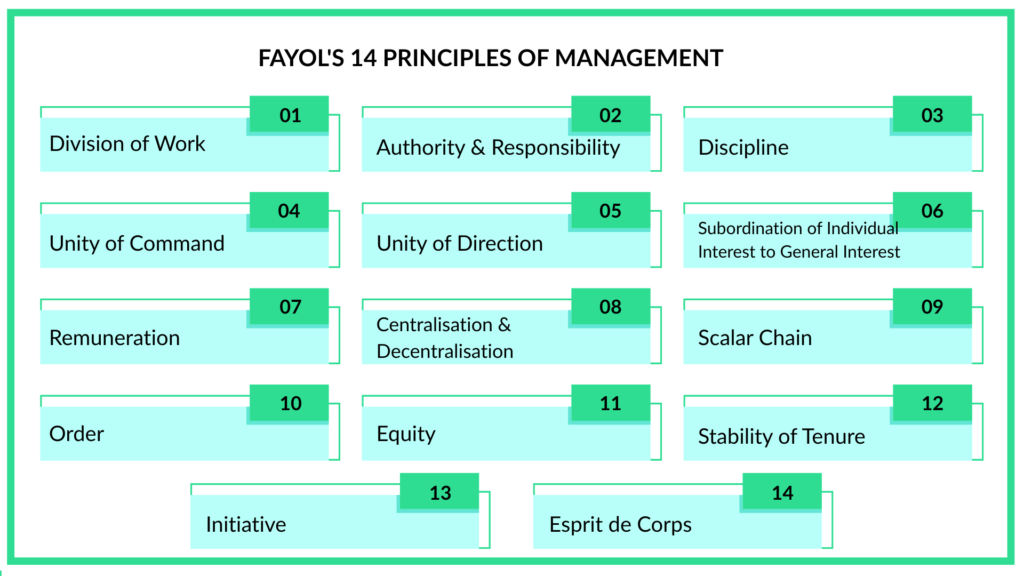
The Fayol’s 14 Principles of Management for UGC NET
Fayol emphasized that these are flexible guidelines, not rigid rules. They need to be adapted based on the situation. Let’s explore each one:
1. Division of Work
Meaning: Work should be divided into smaller, specialized tasks. Each person should handle a specific function rather than doing everything.
Example: In a hospital, doctors diagnose, nurses provide care, pharmacists dispense medicine, and administrators handle paperwork. Imagine if one person did all four — chaos!
Modern Application: Assembly lines in manufacturing, functional departments in organizations (HR, Finance, Marketing), specialization in software teams (frontend, backend, testing).
Key Benefit: Increases efficiency, develops expertise, reduces training time.
2. Authority and Responsibility
Meaning: Authority is the right to give orders and make decisions. Responsibility is the obligation to complete assigned tasks. These two must go hand in hand.
Example: A project manager has the authority to assign tasks and set deadlines, but they’re also responsible if the project fails. You can’t have authority without accountability.
Fayol’s Insight: “Wherever authority is exercised, responsibility arises.” A manager who has authority but avoids responsibility creates dysfunction.
3. Discipline
Meaning: Employees must obey organizational rules, and management must apply penalties fairly and consistently when rules are violated.
Example: A company that tolerates chronic lateness from some employees but punishes others creates resentment. Discipline must be uniform and fair.
Two-way Street: Discipline isn’t just about employees following orders — management must also fulfill their commitments to employees (fair wages, safe conditions, respectful treatment).
4. Unity of Command
Meaning: Each employee should receive orders from only one superior. Having multiple bosses creates confusion, conflict, and divided loyalty.
Example: Imagine your marketing head asks you to prioritize social media campaigns, while the sales head simultaneously demands you focus on cold calling. Who do you listen to? This conflict is what unity of command prevents.
Violation Consequence: Confusion, contradictory instructions, reduced efficiency, organizational politics.
5. Unity of Direction
Meaning: Activities with the same objective should be grouped under one plan and one manager. One head, one plan for a group of activities.
Difference from Unity of Command:
| Unity of Command | Unity of Direction |
|---|---|
| One employee, one boss | One plan, one head for related activities |
| About reporting relationships | About organizational planning |
| Individual-focused | Group/activity-focused |
Example: The entire digital marketing team (SEO, social media, email marketing) should work under one marketing plan led by one marketing head — not three separate plans going in different directions.
6. Subordination of Individual Interest to General Interest
Meaning: The organization’s goals must take precedence over any individual’s personal interests. Personal ambitions shouldn’t undermine collective objectives.
Example: A salesperson who hoards leads instead of sharing with the team (to maximize personal commission) is putting individual interest above organizational interest.
Fayol’s View: Management should reconcile individual and group interests through fair agreements, constant supervision, and good example from leaders.
7. Remuneration
Meaning: Employees should receive fair compensation for their work — neither too low (demotivating) nor excessively high (unjustifiable cost).
Fayol’s Criteria: Remuneration should consider cost of living, business conditions, employee qualifications, and supply-demand of labour.
Modern Application: Competitive salaries, performance bonuses, stock options, benefits packages, and non-monetary rewards like recognition and growth opportunities.
8. Centralisation and Decentralisation
Meaning: The degree to which decision-making authority is concentrated at the top (centralisation) or distributed to lower levels (decentralisation). Fayol argued for optimal balance — not pure centralisation or pure decentralisation.
| Centralisation | Decentralisation |
|---|---|
| Decisions made at the top | Decisions made at lower levels |
| Faster decisions; consistent policies | Faster local responses; employee empowerment |
| Risk of bottleneck | Risk of inconsistency |
| Suitable for small organizations | Suitable for large, diverse organizations |
Example: McDonald’s centralises its menu and branding globally but decentralises menu adaptations to local markets (McAloo Tikki in India, Teriyaki Burger in Japan).
9. Scalar Chain
Meaning: There should be a clear, unbroken line of authority from the top of the organization to the bottom. Communication should follow this chain.
Fayol’s Gang Plank: Fayol recognized that strictly following the chain for every communication would be slow and impractical. So he introduced the concept of a “Gang Plank” (bridge) — allowing two managers at the same level to communicate directly in urgent situations, with their superiors’ permission.
Example: In a company with CEO → VP → Director → Manager → Employee, normally a message from one Manager must go up to the Director, then VP, across to another VP, down to Director, and finally to the other Manager. The gang plank allows the two Managers to talk directly when urgency demands it.
10. Order
Meaning: There should be a proper place for everything (material order) and everyone (social order). Organization of resources and people for maximum efficiency.
Material Order: Right materials in the right place at the right time. Social Order: Right person in the right job.
Example: A well-organized warehouse where every product has a designated shelf versus a chaotic storage room where finding anything takes 30 minutes. Same principle applies to HR — place the right person in the right role.
11. Equity
Meaning: Managers should treat all employees with fairness, justice, and kindness. Equity is a combination of justice (following rules) and kindness (being humane).
Important Distinction: Equity ≠ Equality. Equality means treating everyone the same. Equity means treating everyone fairly, which may mean different treatment based on different needs.
Example: Giving 3 months of maternity leave to a new mother and 3 days of paternity leave to a father isn’t “equal” but may be considered “equitable” based on physical and caregiving needs.
12. Stability of Tenure
Meaning: Employees need time to learn and settle into their roles. High employee turnover is inefficient and costly. Organizations should minimize unnecessary transfers and terminations.
Fayol’s Insight: An employee who has just learned their job and is then transferred is a waste of the training investment. Stability builds competence and organizational knowledge.
Modern Application: Retention programs, career development paths, mentoring, and competitive compensation help maintain stability.
13. Initiative
Meaning: Employees should be encouraged to take initiative — to think creatively, propose new ideas, and take ownership of tasks. This boosts motivation and innovation.
Example: Google’s famous “20% time” (where engineers could spend 20% of their work time on personal projects) is a modern application of this principle. Gmail and Google News were born from employee initiative.
Fayol’s View: A manager must “sacrifice personal vanity” to allow subordinates the freedom to propose and execute ideas.
14. Esprit de Corps
Meaning: “Team spirit.” Management should foster unity, harmony, and a sense of belonging among employees. A cohesive team achieves more than isolated individuals.
Fayol’s Two Rules:
- Don’t divide and rule — Creating factions within the team for easier control ultimately weakens the organization.
- Use verbal communication over written communication when possible — face-to-face builds stronger relationships than memos.
Example: Team outings, collaborative workspaces, group recognition (instead of only individual awards), and open-door policies all build esprit de corps.
The Complete Quick-Reference Table
| No. | Principle | One-Line Summary |
|---|---|---|
| 1 | Division of Work | Specialize tasks for efficiency |
| 2 | Authority & Responsibility | Rights must match obligations |
| 3 | Discipline | Fair, consistent rules for all |
| 4 | Unity of Command | One boss per employee |
| 5 | Unity of Direction | One plan per group of related activities |
| 6 | Subordination of Individual Interest | Organization first, personal second |
| 7 | Remuneration | Fair pay for fair work |
| 8 | Centralisation | Balance top-down and bottom-up decisions |
| 9 | Scalar Chain | Clear chain of authority with gang plank |
| 10 | Order | Right place for everything and everyone |
| 11 | Equity | Fair and kind treatment |
| 12 | Stability of Tenure | Minimize unnecessary turnover |
| 13 | Initiative | Encourage creative thinking |
| 14 | Esprit de Corps | Build team spirit |
Memory Trick: “DR. DISCO NURSES”
This mnemonic covers all Fayol’s 14 principles of Management for UGC NET using first letters:
D — Division of Work, R — Remuneration, D — Discipline, I — Initiative, S — Subordination of Individual Interest, C — Centralisation, O — Order, N — (not a principle — placeholder), U — Unity of Command, R — (not a principle — placeholder), S — Scalar Chain / Stability of Tenure, E — Equity / Esprit de Corps, S — (not a principle — placeholder)
Alternative simpler mnemonic: “DAUD-SCORES-RISE” Division, Authority, Unity of Command, Discipline — Subordination, Centralisation, Order, Remuneration, Equity, Stability — Scalar Chain, Initiative, Esprit de Corps
Frequently Asked Questions
Key Takeaways
- Fayol developed 14 principles from a top-management perspective
- These are flexible guidelines, not rigid rules — adapt to the situation
- Unity of Command and Unity of Direction are distinct concepts (a NET favourite question)
- The Gang Plank concept is Fayol’s practical solution to the rigidity of Scalar Chain
- Fayol vs Taylor comparison is frequently tested
- Understanding each principle with real-world examples helps answer scenario-based questions
For complete Unit 1 Management notes, visit NETsaarthi.in — Your NET journey, simplified.