
Research Ethics UGC NET Paper 1 — Plagiarism, Thesis & Ethics Guide (2026)
Picture this scenario: A researcher discovers a groundbreaking cure for a rare disease. Incredible, right? Then you find out they tested it on people without their consent, fabricated some data to make results look better, and copied half their literature review from another paper. Suddenly, that “breakthrough” isn’t so impressive anymore. This is exactly why research ethics exists — and why UGC NET tests it in Paper 1. As future teachers and researchers, you need to know not just how to do research, but how to do it right.
This topic has gained significant weightage in recent years, especially with UGC’s strict plagiarism regulations. Let’s dive in.
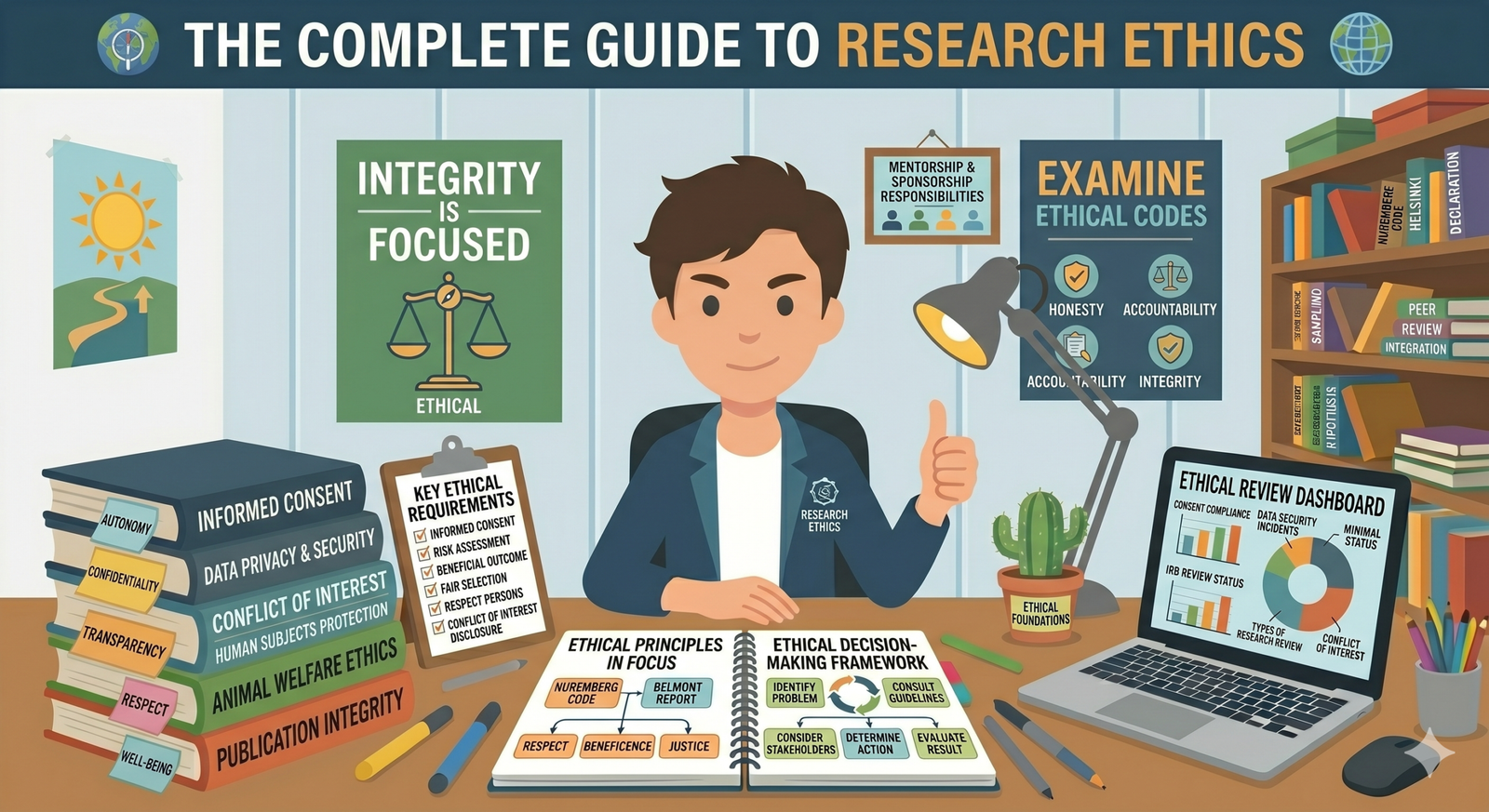
What Are Research Ethics?
Research ethics are the moral principles and rules that guide how research should be conducted. They ensure that research is honest, respectful of human dignity, and contributes genuine knowledge to society.
Think of research ethics as the “traffic rules” of academia. You can be the best driver in the world, but if you run red lights and ignore lane markings, you’re a danger to everyone — including yourself.
The Pillars of Research Ethics
Research ethics rest on several foundational principles:
| Principle | Meaning | Example |
|---|---|---|
| Honesty | Report findings truthfully | Don’t manipulate data to fit your hypothesis |
| Objectivity | Avoid bias in design, analysis, and interpretation | Don’t let personal beliefs skew your conclusions |
| Integrity | Keep promises and act consistently | Follow through on commitments to participants |
| Carefulness | Avoid errors and negligence | Double-check data, cite sources accurately |
| Openness | Share data and methods transparently | Make your methodology reproducible |
| Respect for Intellectual Property | Give credit where it’s due | Cite sources, avoid plagiarism |
| Confidentiality | Protect participant information | Anonymize data, secure records |
| Non-discrimination | Don’t exclude based on gender, race, etc. | Ensure diverse and fair participant selection |
| Social Responsibility | Consider the impact of research on society | Don’t conduct research that harms public welfare |
Plagiarism — The Biggest Ethical Violation
What Is Plagiarism?
Plagiarism is presenting someone else’s work, ideas, or words as your own without proper acknowledgment. It’s the academic equivalent of stealing — and UGC takes it very seriously.
Types of Plagiarism
This is a frequent exam question, so know each type well:
1. Direct Plagiarism (Verbatim Copying): Copying someone’s text word-for-word without quotation marks or citation. Example: Copy-pasting a paragraph from a journal article into your thesis without quotes or reference.
2. Self-Plagiarism: Reusing your own previously published work without disclosing it. Yes, you can plagiarize yourself. Example: Submitting the same research paper to two different journals without telling either one.
3. Mosaic Plagiarism (Patchwork): Taking phrases from various sources and stitching them together, changing a few words here and there. Example: Paraphrasing multiple sources but keeping the original sentence structure and just swapping synonyms.
4. Accidental Plagiarism: Failing to cite sources or misquoting due to carelessness rather than intentional deceit. Still a violation — ignorance isn’t an excuse.
5. Source-Based Plagiarism: Citing a source incorrectly or citing a secondary source as if you read the primary source directly.
UGC Regulations on Plagiarism (2018)
UGC released comprehensive plagiarism regulations in 2018. Here are the penalty levels you must memorize:
| Similarity Level | Penalty |
|---|---|
| Up to 10% | No penalty — minor similarity is acceptable |
| 10% to 40% | Student must resubmit the work; faculty member gets a warning |
| 40% to 60% | Student is debarred from submitting for 1 year; faculty loses annual increment for 1 year |
| Above 60% | Student’s registration is cancelled; faculty is suspended for 2 years |
Tools for Detection: UGC mandates the use of plagiarism detection software. The most commonly used tools include Turnitin, Urkund (now Ouriginal), and iThenticate. Every university in India is now require to have institutional access to such tools.
Key Historical Codes of Research Ethics
UGC NET frequently asks about the historical development of ethical guidelines. These emerged largely from horrific abuses in research history.
The Nuremberg Code (1947)
Background: During World War II, Nazi doctors conducted brutal experiments on concentration camp prisoners — freezing them, injecting diseases, performing surgeries without anesthesia. After the war, the Nuremberg Trials convict these doctors, and the Nuremberg Code was establish to prevent such horrors.
Key Principles:
- Voluntary consent of the participant is absolutely essential
- The experiment should be designed to yield beneficial results
- Risks should be proportional to the expected benefits
- The participant can withdraw at any time
- The researcher must be scientifically qualified
NET Memory Tip: Nuremberg = “Never Again” — these rules ensure unethical experiments never happen again.
The Declaration of Helsinki (1964)
Who created it? The World Medical Association (WMA)
Purpose: Ethical principles for medical research involving human subjects. It expanded on the Nuremberg Code and has been revised multiple times (most recently in 2013).
Key Additions Beyond Nuremberg:
- Introduced the concept of Ethics Review Committees (now called Institutional Review Boards/IRBs)
- Distinguished between therapeutic research (benefits the patient) and non-therapeutic research (benefits knowledge)
- Emphasized the need for informed consent in written form
- Required special protections for vulnerable populations (children, prisoners, mentally ill)
NET Memory Tip: Helsinki sounds like “Help-sinki” — it was designed to help protect research participants.
The Belmont Report (1979)
Created by: The National Commission for the Protection of Human Subjects (USA)
Three Core Principles:
| Principle | Meaning | Application |
|---|---|---|
| Respect for Persons | Treat individuals as autonomous agents | Informed consent process |
| Beneficence | Do no harm; maximize benefits | Risk-benefit analysis |
| Justice | Fair distribution of research benefits and burdens | Fair participant selection |
Informed Consent — The Cornerstone of Ethics
Informed consent means that a research participant voluntarily agrees to participate after being fully informed about the study’s purpose, procedures, risks, benefits, and their right to withdraw.
Elements of Valid Informed Consent
- Disclosure — Researcher explains the study fully
- Understanding — Participant comprehends what they’re agreeing to
- Voluntariness — No coercion, pressure, or undue influence
- Competence — Participant is mentally capable of making the decision
- Consent — Participant explicitly agrees (usually in writing)
Special Cases
- Children: Consent from parent/guardian + assent from the child
- Prisoners: Extra safeguards due to coercive environment
- Emergency situations: Consent may be waived under strict conditions
- Deception studies: Debriefing must happen immediately after the study
Thesis and Dissertation — Structure and Ethics
Difference Between Thesis and Dissertation
This distinction varies by country, but for UGC NET purposes:
| Feature | Thesis | Dissertation |
|---|---|---|
| Level | Usually for PhD | Usually for Master’s |
| Purpose | Original contribution to knowledge | Demonstrates research competence |
| Length | Typically longer (200-500 pages) | Shorter (100-200 pages) |
| Originality | Must present new findings | Can be a compilation and analysis of existing work |
Standard Structure of a Research Thesis
- Title Page — Title, author name, university, year
- Abstract — Brief summary (250-300 words)
- Acknowledgments — Thanks to guides, funding bodies
- Table of Contents — Chapter-wise listing
- Chapter 1: Introduction — Background, problem statement, objectives, hypotheses
- Chapter 2: Review of Literature — What previous research has found
- Chapter 3: Research Methodology — Design, sample, tools, procedures
- Chapter 4: Data Analysis & Interpretation — Statistical analysis, findings
- Chapter 5: Conclusions & Suggestions — Summary, implications, future scope
- Bibliography/References — All cited works
- Appendices — Questionnaires, raw data, supplementary materials
Citation and Referencing Styles
| Style | Used In | Example |
|---|---|---|
| APA | Psychology, Education, Social Sciences | (Smith, 2023) |
| MLA | Humanities, Literature | (Smith 45) |
| Chicago | History, Arts | Footnotes/endnotes |
| Harvard | General academic use | (Smith 2023, p. 45) |
| IEEE | Engineering, Technology | [1] numbered system |
Research Ethics For UGC NET, APA is the most commonly referenced style.
Research Misconduct — Beyond Plagiarism
Plagiarism is just one form of misconduct. The full spectrum includes:
Fabrication — Making up data or results that don’t exist. Example: A researcher claims to have surveyed 500 people but actually only surveyed 100 and invented the rest.
Falsification — Manipulating data, equipment, or processes to change results. Example: Removing data points that don’t support the hypothesis while keeping those that do.
FFP — The Deadly Trio: Fabrication, Falsification, Plagiarism. These are the three most serious forms of research misconduct recognized internationally.
Other Forms:
- Ghost Authorship — A person who contributed significantly is not listed as author
- Gift Authorship — A person who didn’t contribute is listed as author (often a senior professor)
- Salami Slicing — Breaking one study into multiple publications to inflate publication count
- Conflict of Interest — Not disclosing financial or personal interests that could bias research
Intellectual Property Rights (IPR)
Research ethics extends to respecting intellectual property. Key concepts:
| Term | Definition |
|---|---|
| Copyright | Legal right protecting original creative works (books, articles, software) |
| Patent | Protects inventions and processes for a limited period (usually 20 years) |
| Trademark | Protects brand names, logos, and slogans |
| Trade Secret | Confidential business information (formulas, processes) |
Under Research Ethics For UGC NET: Focus on copyright (most relevant to academic publishing) and patents (relevant to research innovations).
Frequently Asked Questions
Key Takeaways
- Research ethics topic in UGC NET ensure honesty, integrity, and respect in the research process
- Plagiarism has multiple types — direct, self, mosaic, accidental, and source-based
- UGC’s 2018 regulations define clear penalties for different levels of plagiarism
- The Nuremberg Code, Helsinki Declaration, and Belmont Report are landmark ethical documents
- Informed consent is the cornerstone of ethical research involving human participants
- FFP (Fabrication, Falsification, Plagiarism) are the three most serious forms of misconduct
Continue your UGC NET preparation with more in-depth notes at NETsaarthi.in — Your NET journey, simplified.