
UGC NET Syllabus 2026 — Paper 1 & Paper 2 Management Complete Breakdown
Before you pick up a single book or watch a single lecture, the very first thing you need is a crystal-clear understanding of the UGC NET Syllabus. Without it, you’re navigating without a map — studying random topics, missing important ones, and wasting precious time.
This article gives you the complete, updated UGC NET syllabus 2026 for both Paper 1 (General Aptitude) and Paper 2 (Management), along with topic-wise weightage analysis so you know exactly where to invest your energy.
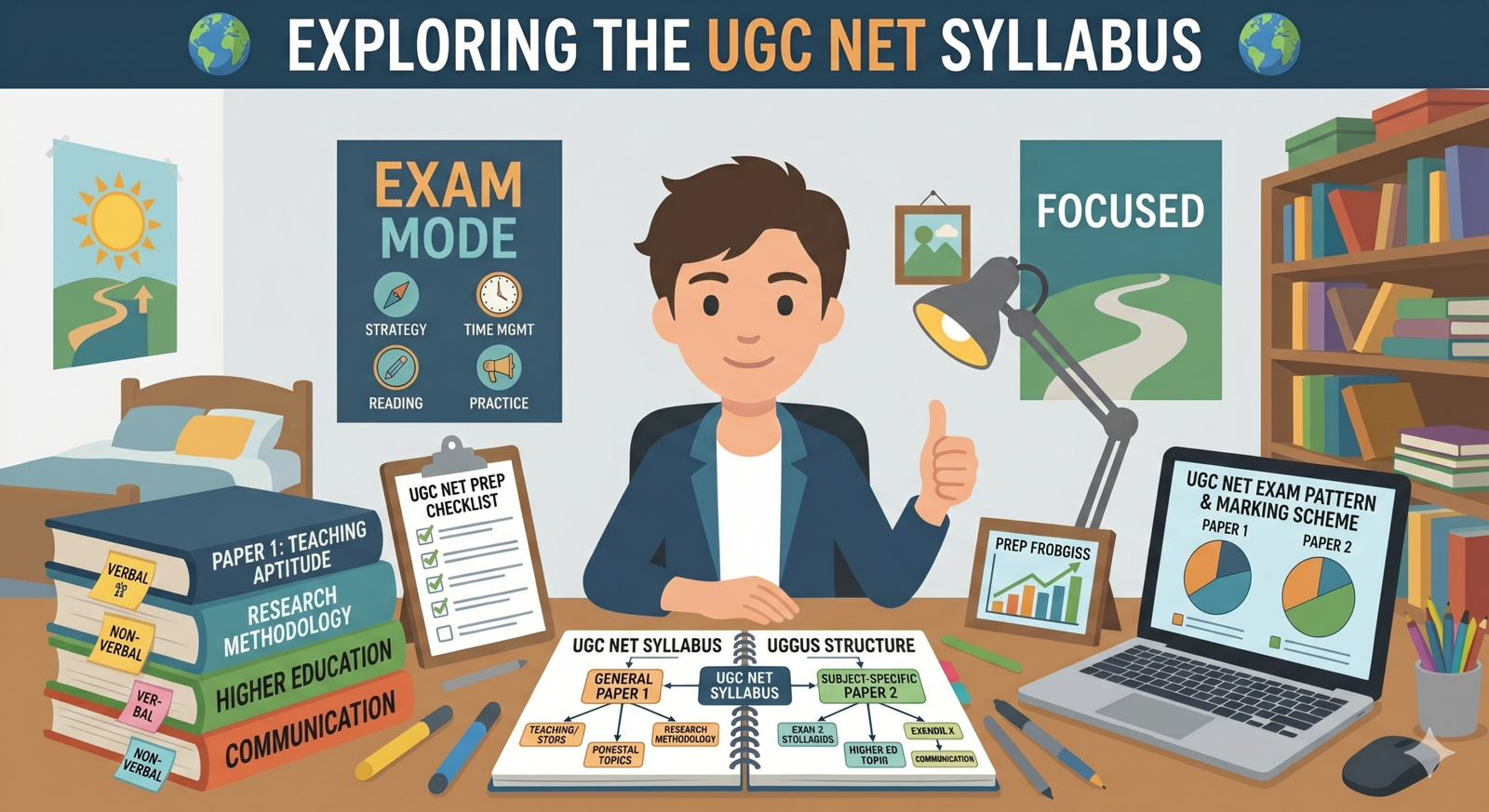
UGC NET 2026 — Exam Pattern at a Glance
| Parameters | Details |
|---|---|
| Conducting Body | NTA (National Testing Agency) |
| Exam Mode | Computer-Based Test (CBT) |
| Total Papers | 2 (Paper 1 + Paper 2, conducted together) |
| Total Duration | 3 hours (combined, no break) |
| Total Questions | 150 (50 in Paper 1 + 100 in Paper 2) |
| Total Marks | 300 (100 + 200) |
| Negative Marking | None |
| Question Type | Objective MCQs |
| Purpose | JRF (Junior Research Fellowship) + Assistant Professor eligibility |
| Management Subject Code | 17 |
Important: Since there’s no negative marking, you should attempt every single question. Even a random guess has a 25% chance of scoring 2 marks.
Paper 1 UGC NET Syllabus 2026— General Aptitude (50 Questions, 100 Marks)
Paper 1 is common for all subjects. Whether you’re appearing for Management, English, or Political Science, everyone answers the same Paper 1.
Unit 1: Teaching Aptitude
| Topic | Key Areas |
|---|---|
| Teaching: Concept, Objectives, Levels | Memory, Understanding, Reflective levels (Herbart, Morrison, Hunt) |
| Characteristics of Teaching | Learner-centered, teacher-centered approaches |
| Teaching Methods | Lecture, discussion, project, case study, problem-solving |
| Evaluation Systems | Formative, summative, diagnostic; CCE |
| Bloom’s Taxonomy | Original (1956) and Revised (2001); cognitive, affective, psychomotor domains |
Estimated Questions: 5-7 | Weightage: Very High
Unit 2: Research Aptitude
| Topic | Key Areas |
|---|---|
| Research: Meaning, Types, Characteristics | Fundamental, Applied, Action; Quantitative, Qualitative |
| Research Methods | Descriptive, Experimental, Historical, Ex Post Facto |
| Sampling | Probability (random, stratified, cluster) and Non-probability (purposive, snowball) |
| Hypothesis | Types, formulation, testing |
| Research Ethics | Plagiarism, informed consent, Nuremberg Code, Helsinki Declaration |
| Thesis Writing | Structure, referencing styles (APA, MLA), UGC plagiarism regulations |
Estimated Questions: 5-7 | Weightage: Very High
Unit 3: Reading Comprehension
A passage is provided with questions testing your ability to understand, interpret, and draw inferences. No specific syllabus — it tests comprehension skills.
Estimated Questions: 5 | Weightage: Medium
Unit 4: Communication
| Topic | Key Areas |
|---|---|
| Communication: Nature, Types | Verbal, non-verbal, formal, informal |
| Models of Communication | Aristotle, Shannon-Weaver, Berlo’s SMCR, Schramm |
| Barriers to Communication | Physical, semantic, psychological, cultural |
| Effective Classroom Communication | 7 Cs, mass media, ICT-enabled communication |
Estimated Questions: 4-5 | Weightage: High
Unit 5: Mathematical Reasoning & Aptitude
Number series, letter series, coding-decoding, data sufficiency, basic numeracy, percentages, fractions, LCM/HCF, ratio, averages, puzzles.
Estimated Questions: 4-5 | Weightage: Medium
Unit 6: Logical Reasoning
| Topic | Key Areas |
|---|---|
| Western Logic | Syllogisms, Venn diagrams, propositions (A, E, I, O), analogies |
| Indian Logic | Pramanas, Anumana (5 Avayavas), Hetvabhasa (5 fallacies), Nyaya school |
| Deductive & Inductive Reasoning | Structure, validity, patterns |
Estimated Questions: 5-6 | Weightage: Very High
Unit 7: Data Interpretation
Tables, bar graphs, pie charts, line graphs, histograms. Questions on percentages, averages, ratios, and trend analysis.
Estimated Questions: 5 | Weightage: High
Unit 8: Information & Communication Technology (ICT)
| Topic | Key Areas |
|---|---|
| ICT Basics | Internet, networking (LAN/WAN), cybersecurity |
| E-Learning Platforms | SWAYAM, SWAYAM Prabha, NPTEL, e-PG Pathshala, DIKSHA, NDLI |
| MOOCs | xMOOC vs cMOOC, global platforms (Coursera, edX) |
| INFLIBNET Services | Shodhganga, N-LIST, Shodh Shuddhi, e-ShodhSindhu |
| Digital Initiatives | Digital India, DigiLocker, UMANG |
Estimated Questions: 4-5 | Weightage: High
Unit 9: People, Development & Environment
| Topic | Key Areas |
|---|---|
| Environmental Issues | Pollution types, greenhouse effect, ozone depletion, acid rain |
| Sustainable Development | Brundtland Commission, SDGs (17 goals), MDGs vs SDGs |
| Natural Hazards | Earthquakes, cyclones, floods, disaster management cycle |
| Environmental Legislation | Environment Protection Act 1986, Wildlife Protection Act, NGT |
Estimated Questions: 3-5 | Weightage: Medium
Unit 10: Higher Education System
| Topic | Key Areas |
|---|---|
| Education Bodies | UGC, NAAC, AICTE, NCTE, NIRF, AIU |
| NEP 2020 | 5+3+3+4 structure, ABC, NRF, HECI, M.Phil discontinuation |
| Types of Universities | Central, State, Deemed, Private, Institutes of National Importance |
| Historical Commissions | Radhakrishnan, Kothari, NPE 1986, POA 1992 |
| Distance Education | IGNOU, ODL regulations |
Estimated Questions: 3-5 | Weightage: High
Paper 2 UGC NET Syllabus 2026 — Management (100 Questions, 200 Marks)
Paper 2 tests your in-depth knowledge of Management at the postgraduate level.
Unit 1: Management Principles & Process
Functions of management (POSDCORB), Fayol’s 14 Principles, Taylor’s Scientific Management, MBO (Drucker), Decision-making, Social Responsibility of Business.
Unit 2: Organizational Behaviour & HRM
Motivation theories (Maslow, Herzberg, McGregor, Vroom, McClelland), Leadership theories (Trait, Behavioural, Contingency), Group dynamics, Organizational culture, Conflict management, HRM functions (recruitment, selection, training, appraisal, compensation), Industrial relations.
Unit 3: Marketing Management
Marketing concepts and orientations, STP (Segmentation, Targeting, Positioning), Marketing Mix (4Ps, 7Ps), Consumer behaviour, Product Life Cycle, Pricing strategies, Promotion mix, Branding, Digital marketing, Services marketing.
Unit 4: Financial Management & Accounting
Capital budgeting (NPV, IRR, Payback), Cost of capital, Capital structure, Working capital management, Ratio analysis, Sources of finance, Dividend policy, Leverage, Financial statements.
Unit 5: Quantitative Techniques for Management
Measures of central tendency, Dispersion, Correlation and Regression, Probability, Hypothesis testing, ANOVA, Chi-square, Time series analysis, Index numbers.
Unit 6: Production & Operations Management
Production planning and control, Facility location and layout, Inventory management (EOQ, ABC, JIT), Quality management (TQM, Six Sigma, ISO), Supply chain management, Project management (PERT/CPM).
Unit 7: Strategic Management
Mission, Vision, Objectives, SWOT analysis, Porter’s Five Forces, Generic strategies, BCG Matrix, Ansoff Matrix, Value chain, Corporate and business-level strategy, Strategic implementation.
Unit 8: Business Environment & International Business
PESTLE analysis, LPG reforms 1991, WTO, FDI/FPI, Trade theories (Smith, Ricardo, H-O, Vernon), Balance of payments, Exchange rates, Globalization, Regional trade agreements.
Unit 9: Corporate Governance, Ethics & CSR
Corporate governance principles, SEBI guidelines, Board structure, CSR (Section 135), Carroll’s Pyramid, Business ethics theories, Governance committees (Birla, Narayana Murthy, Kotak).
Unit 10: Entrepreneurship, Innovation & Small Business
Entrepreneur types (Danhof), Theories (Schumpeter, McClelland), MSME classification, Government schemes (MUDRA, Startup India), Innovation management, Intrapreneurship, Business incubators.
Unit-Wise Weightage Summary (Paper 2)
| Unit | Topic | Approx. Questions | Priority |
|---|---|---|---|
| 1 | Management Principles | 10-12 | Very High |
| 2 | OB & HRM | 12-15 | Very High |
| 3 | Marketing | 10-12 | Very High |
| 4 | Financial Management | 10-12 | High |
| 5 | Quantitative Techniques | 8-10 | Medium |
| 6 | Operations Management | 8-10 | Medium |
| 7 | Strategic Management | 8-10 | Very High |
| 8 | Business Environment & IB | 8-10 | High |
| 9 | Corporate Governance | 6-8 | Medium |
| 10 | Entrepreneurship | 6-8 | Medium |
How to Use This Syllabus Strategically
- Step 1: Print or save this syllabus breakdown. Tick off topics as you study them.
- Step 2: Start with Very High priority units — they cover 50-55 questions in Paper 2.
- Step 3: Cross-reference with previous year papers to identify the most frequently asked sub-topics within each unit.
- Step 4: For Paper 1, the syllabus is finite and predictable. Most topics can be mastered in 45-60 days of focused preparation.
- Step 5: Use this syllabus as your revision checklist in the final week — quickly scan each topic and ensure you’ve covered it.
Frequently Asked Questions
Key Takeaways
- Paper 1: 10 units, 50 questions, 100 marks — common for all subjects
- Paper 2: 10 units, 100 questions, 200 marks — subject-specific (Management)
- No negative marking — attempt every question
- OB/HRM, Marketing, and General Management are the highest-weightage Paper 2 units
- Teaching Aptitude, Research Aptitude, and Logical Reasoning dominate Paper 1
- Syllabus hasn’t changed since 2019, but questions reflect current trends
Get unit-wise notes for every topic in this syllabus at NETsaarthi.in — Your NET journey, simplified.