
Marketing Mix UGC NET Management— 4Ps, 7Ps & STP Strategy Explained (2026)
Every time you pick Amul butter over a cheaper brand, or choose Amazon over a local store, or respond to a Zomato notification offering 60% off — you’re being influenced by someone’s marketing mix decisions. The product quality (Product), the discount (Price), the app convenience (Place), and the push notification (Promotion) all work together to make you buy. Marketing Management is one of the highest-weightage units in UGC NET Paper 2, and the Marketing Mix is its centrepiece. Let’s master it.
What Is Marketing?
Philip Kotler (the “Father of Modern Marketing”) defines marketing as: “The science and art of exploring, creating, and delivering value to satisfy the needs of a target market at a profit.”
American Marketing Association (AMA) Definition: Marketing is the activity, set of institutions, and processes for creating, communicating, delivering, and exchanging offerings that have value for customers, clients, partners, and society at large.
STP — The Foundation Before the Mix
Before designing a marketing mix, companies must answer: “Who exactly are we marketing to?” This is the STP process:
1. Segmentation — Dividing the Market
| Basis | What It Considers | Example |
|---|---|---|
| Geographic | Region, city size, climate, density | Different flavours of Maggi for South India vs North India |
| Demographic | Age, gender, income, education, occupation | Luxury cars for high-income groups |
| Psychographic | Lifestyle, personality, values, attitudes | Organic food for health-conscious consumers |
| Behavioural | Usage rate, brand loyalty, benefits sought | Frequent flyer programs for loyal customers |
2. Targeting — Selecting Your Segment
| Strategy | Description | Example |
|---|---|---|
| Undifferentiated | One product for entire market | Salt, sugar |
| Differentiated | Different products for different segments | Maruti (Alto for budget, Brezza for mid-range, Ciaz for premium) |
| Concentrated (Niche) | One product for one specific segment | Rolls Royce (ultra-luxury only) |
| Micromarketing | Customised for individuals or local areas | Netflix recommendations based on your viewing history |
3. Positioning — Creating a Distinct Image
Positioning is about occupying a unique place in the consumer’s mind. It answers: “Why should customers choose US over competitors?”
Positioning Strategies:
- Based on product attributes (Volvo = safety)
- Based on price/quality (Walmart = low prices)
- Based on usage (Gatorade = sports performance drink)
- Based on competitor (Pepsi positioning against Coke)
- Based on user (Johnson’s Baby = for babies → also for adults who want gentle care)
The Marketing Mix — 4Ps (McCarthy, 1960)
E. Jerome McCarthy organised marketing activities into four categories — the 4Ps:
1. Product
A product is anything offered to a market to satisfy a need or want. It can be tangible (goods) or intangible (services).
Kotler’s Five Levels of Product:
| Level | Description | Example (Smartphone) |
|---|---|---|
| Core Benefit | The fundamental need the product satisfies | Communication |
| Basic Product | The basic version of the product | A phone that makes calls |
| Expected Product | Features customers normally expect | Touchscreen, camera, internet |
| Augmented Product | Additional features that exceed expectations | Free cloud storage, extended warranty |
| Potential Product | All possible future enhancements | Foldable screens, holographic display |
Product Life Cycle (PLC):
| Stage | Sales | Profit | Strategy |
|---|---|---|---|
| Introduction | Low | Negative/Low | Create awareness; heavy promotion |
| Growth | Rapidly increasing | Increasing | Expand distribution; build brand |
| Maturity | Peak, then stable | Peak, then declining | Defend market share; differentiate |
| Decline | Falling | Falling | Harvest, divest, or revive |
2. Price
Price is the amount of money charged for a product. It’s the only P that generates revenue — the other three Ps are costs.
Pricing Strategies:
| Strategy | Description | Example |
|---|---|---|
| Penetration Pricing | Low initial price to gain market share quickly | Jio’s free data launch in India |
| Skimming Pricing | High initial price, gradually reduced | New iPhone launch at premium price |
| Competitive Pricing | Price set based on competitors’ pricing | Pepsi matching Coca-Cola’s prices |
| Cost-Plus Pricing | Cost + fixed markup percentage | Government contracts |
| Value-Based Pricing | Price based on perceived value to customer | Designer clothing, luxury brands |
| Psychological Pricing | Price set to influence perception | ₹999 instead of ₹1,000 |
| Bundle Pricing | Multiple products sold together at a discount | McDonalds combo meals |
3. Place (Distribution)
Place refers to how and where the product is made available to customers. It’s about distribution channels and logistics.
Distribution Channels:
| Level | Structure | Example |
|---|---|---|
| Zero Level (Direct) | Manufacturer → Consumer | Dell selling directly online |
| One Level | Manufacturer → Retailer → Consumer | Clothing brands in malls |
| Two Level | Manufacturer → Wholesaler → Retailer → Consumer | FMCG products (Hindustan Unilever) |
| Three Level | Manufacturer → Agent → Wholesaler → Retailer → Consumer | International products entering India |
Distribution Strategies:
- Intensive: Available everywhere (Coca-Cola in every shop)
- Selective: Available in selected outlets (Samsung in authorized stores)
- Exclusive: Available in very few outlets (Louis Vuitton boutiques)
4. Promotion
In Marketing Mix, Promotion is all communication activities to inform, persuade, and remind customers about the product.
Promotion Mix (Tools):
| Tool | Description | Example |
|---|---|---|
| Advertising | Paid, non-personal communication through mass media | TV commercials, Google Ads, billboards |
| Sales Promotion | Short-term incentives to encourage purchase | Discounts, coupons, “Buy 1 Get 1” |
| Personal Selling | Direct face-to-face interaction | Insurance agents, B2B sales representatives |
| Public Relations (PR) | Managing the company’s public image | Press releases, events, CSR activities |
| Direct Marketing | Direct communication with individual customers | Email campaigns, SMS, catalogues |
| Digital Marketing | Online channels for marketing | Social media, SEO, influencer marketing |
AIDA Model (Attention → Interest → Desire → Action): The framework for effective promotional messaging — first grab attention, then build interest, then create desire, and finally drive action.
Extended Marketing Mix — 7Ps (Booms & Bitner, 1981)
For services marketing, three additional Ps were added:
| Additional P | Description | Example |
|---|---|---|
| People | All human actors in the service delivery | Friendly waiters in a restaurant, skilled doctor in a hospital |
| Process | The procedures and flow of service delivery | Online food ordering process, bank loan approval steps |
| Physical Evidence | Tangible cues that represent the service | Clean hospital building, professional website design, employee uniforms |
Why 7Ps for services? Services are intangible, inseparable (produced and consumed simultaneously), variable (quality varies), and perishable (can’t be stored). The extra 3Ps address these unique characteristics.
Consumer Behaviour Basics
Understanding WHY consumers buy is essential for designing the right marketing mix.
Consumer Buying Decision Process:
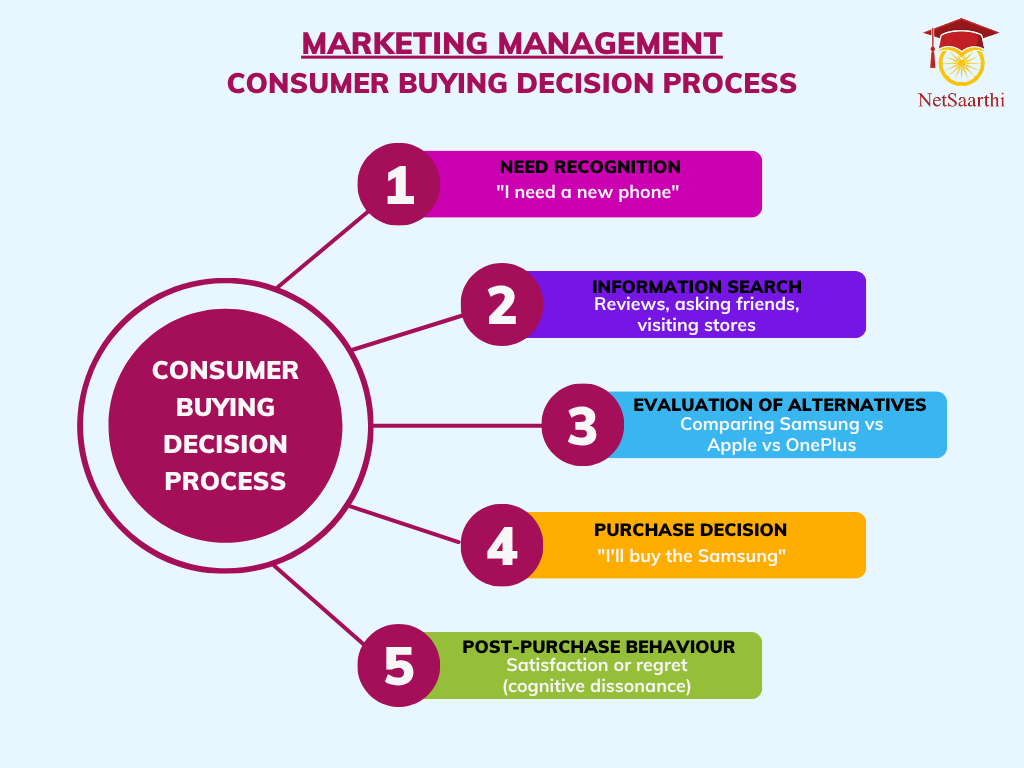
- Need Recognition — “I need a new phone”
- Information Search — Reviews, asking friends, visiting stores
- Evaluation of Alternatives — Comparing Samsung vs Apple vs OnePlus
- Purchase Decision — “I’ll buy the Samsung”
- Post-Purchase Behaviour — Satisfaction or regret (cognitive dissonance)
Factors Influencing Consumer Behaviour:
- Cultural: Culture, subculture, social class
- Social: Reference groups, family, roles, status
- Personal: Age, occupation, lifestyle, personality
- Psychological: Motivation, perception, learning, attitudes
Frequently Asked Questions
Key Takeaways
- STP (Segmentation, Targeting, Positioning) precedes the marketing mix
- 4Ps: Product, Price, Place, Promotion — McCarthy (1960)
- 7Ps add People, Process, Physical Evidence — for services (Booms & Bitner, 1981)
- Price is the only revenue-generating P; the rest are costs
- Product Life Cycle has 4 stages requiring different strategies
- Consumer buying follows 5 stages from need recognition to post-purchase behaviour
Explore complete Marketing Mix UGC NET Management notes at NETsaarthi.in — Your NET journey, simplified.