
Leadership Theories UGC NET Management — Trait, Behavioural & Situational (2026)
Is a leader born or made? Can anyone become a great leader, or is it reserved for those with special qualities? These questions have fascinated management thinkers for over a century, and their answers form the foundation of Leadership Theories — one of the most important and frequently tested topics in UGC NET Paper 2 Management.
What Is Leadership?
Leadership is the ability to influence, inspire, and guide individuals or groups toward achieving common goals. It’s not about position or title — it’s about impact.
Leadership vs Management:
| Leadership | Management |
|---|---|
| Inspires and motivates | Plans and organizes |
| Focuses on people | Focuses on systems and processes |
| Creates vision | Implements vision |
| Takes risks | Minimizes risks |
| Does the right things | Does things right |
| Influences voluntarily | Exercises formal authority |
Evolution of Leadership Theories
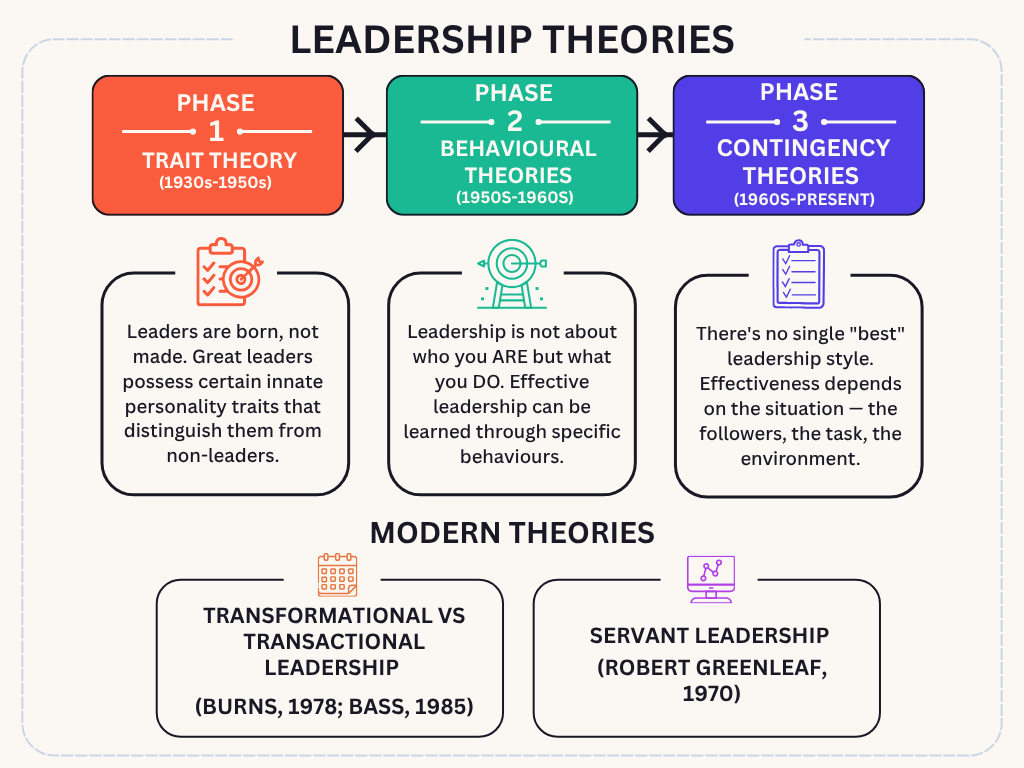
Leadership theories UGC NET Management evolved through three major phases:
Phase 1: Trait Theory (1930s-1950s)
Core Idea: Leaders are born, not made. Great leaders possess certain innate personality traits that distinguish them from non-leaders.
Key Traits Identified:
- Intelligence and judgment
- Self-confidence
- Determination and drive
- Integrity and honesty
- Sociability and interpersonal skills
- Emotional stability
- Physical appearance and energy
Stogdill’s Research (1948): Ralph Stogdill reviewed 124 studies and found that while certain traits correlated with leadership, no single set of traits guaranteed leadership success. Context and situation mattered enormously.
Criticism:
- Too many traits identified — no universal “leadership trait list” agreed upon
- Ignores the situation and followers
- Many people with these traits are NOT leaders, and many leaders lack some of these traits
- Doesn’t explain HOW traits translate into leadership effectiveness
Phase 2: Behavioural Theories (1950s-1960s)
Core Idea: Leadership is not about who you ARE but what you DO. Effective leadership can be learned through specific behaviours.
Ohio State Studies (1940s-1950s)
Researchers at Ohio State University identified two independent dimensions of leader behaviour:
| Dimension | Focus | Behaviours |
|---|---|---|
| Initiating Structure | Task-oriented | Defining roles, setting goals, organizing work, establishing procedures |
| Consideration | Relationship-oriented | Showing concern for followers, building trust, respecting ideas, fostering warmth |
Key Finding: These are independent — a leader can be HIGH on both, LOW on both, or any combination. The most effective leaders scored high on both initiating structure AND consideration.
Michigan Studies (1950s)
University of Michigan researchers identified two similar styles:
| Style | Focus | Corresponding Ohio State Dimension |
|---|---|---|
| Production-Oriented | Task completion, efficiency, technical aspects | Initiating Structure |
| Employee-Oriented | Interpersonal relationships, employee welfare | Consideration |
Key Finding: Employee-oriented leaders were generally associated with higher group productivity and satisfaction, unlike Ohio State’s finding that both dimensions matter equally.
Blake and Mouton’s Managerial Grid (1964)
Robert Blake and Jane Mouton created a grid plotting two dimensions: Concern for People (Y-axis) and Concern for Production (X-axis), each rated 1-9.
| Grid Position | Name | Description |
|---|---|---|
| (1,1) | Impoverished Management | Low concern for both people and production; minimum effort |
| (9,1) | Authority-Compliance (Task) | High production focus, low people concern; dictatorial |
| (1,9) | Country Club Management | High people concern, low production; friendly but unproductive |
| (5,5) | Middle-of-the-Road | Moderate concern for both; adequate but not outstanding |
| (9,9) | Team Management | High concern for both; most effective style |
For NET: Remember that (9,9) Team Management is considered the ideal style. Questions often ask you to identify grid positions based on descriptions.
Phase 3: Situational/Contingency Theories (1960s-present)
Core Idea: There’s no single “best” leadership style. Effectiveness depends on the situation — the followers, the task, the environment.
Fiedler’s Contingency Model (1967)
Fred Fiedler proposed that leadership effectiveness depends on the match between the leader’s style and the favourability of the situation.
Leader Style (Fixed): Measured by the Least Preferred Co-worker (LPC) Scale
- High LPC = Relationship-oriented leader
- Low LPC = Task-oriented leader
Situational Favourability: Determined by three factors:
| Factor | Most Favourable | Least Favourable |
|---|---|---|
| Leader-Member Relations | Good | Poor |
| Task Structure | High (clear) | Low (ambiguous) |
| Position Power | Strong | Weak |
Key Finding:
- Task-oriented leaders perform better in VERY favourable or VERY unfavourable situations
- Relationship-oriented leaders perform better in MODERATELY favourable situations
Critical Implication: Since leadership style is relatively fixed (according to Fiedler), organizations should change the situation to fit the leader, not try to change the leader.
Hersey and Blanchard’s Situational Leadership (1969)
This model focuses on follower maturity (readiness) as the key situational variable.
| Follower Maturity | Leadership Style | Leader Behaviour |
|---|---|---|
| M1 — Low (unable, unwilling) | Telling (S1) | High task, low relationship |
| M2 — Low-Moderate (unable, willing) | Selling (S2) | High task, high relationship |
| M3 — Moderate-High (able, unwilling) | Participating (S3) | Low task, high relationship |
| M4 — High (able, willing) | Delegating (S4) | Low task, low relationship |
Example: A brand-new employee (M1) needs clear instructions (Telling). An experienced but demotivated employee (M3) needs encouragement and involvement (Participating). A highly competent and committed employee (M4) just needs to be left alone (Delegating).
Path-Goal Theory (Robert House, 1971)
The leader’s job is to clear the path for followers to achieve their goals by removing obstacles and providing direction.
Four Leadership Styles:
| Style | When to Use |
|---|---|
| Directive | Ambiguous tasks, inexperienced followers |
| Supportive | Stressful or boring tasks, need for emotional support |
| Participative | Complex decisions needing follower input |
| Achievement-Oriented | Challenging goals, high-achiever followers |
Modern Leadership Concepts
Transformational vs Transactional Leadership (Burns, 1978; Bass, 1985)
| Transactional | Transformational |
|---|---|
| Exchange-based (reward for performance) | Inspiration-based (vision for change) |
| Maintains status quo | Creates change |
| Short-term focus | Long-term vision |
| Uses rewards and punishments | Inspires intrinsic motivation |
| Management-oriented | Leadership-oriented |
Transformational Leadership’s 4 I’s:
- Idealized Influence — Leader serves as a role model
- Inspirational Motivation — Creates a compelling vision
- Intellectual Stimulation — Encourages creative thinking
- Individualized Consideration — Attends to each follower’s needs
Servant Leadership (Robert Greenleaf, 1970)
The leader’s primary role is to serve followers — their growth, well-being, and development come first. The leader leads by serving.
Frequently Asked Questions
Key Takeaways
- Leadership theories evolved from Trait → Behavioural → Situational/Contingency
- Ohio State studies identified Initiating Structure and Consideration as two key dimensions
- Blake-Mouton Grid: (9,9) Team Management is ideal
- Fiedler: Match leader style to situation; don’t try to change the leader
- Hersey-Blanchard: Adapt style based on follower maturity
- Transformational leadership (4 I’s) is the modern gold standard
Get complete OB notes at NETsaarthi.in — Your NET journey, simplified.