
Types of Research UGC NET Paper 1 — Complete Guide with Examples (2026)
If Teaching Aptitude is the heart of UGC NET Paper 1, then Research Aptitude is definitely the brain. And right at the centre of this unit sits one of the most frequently tested topics — Types of Research of UGC NET.
Sounds straightforward, right? Just a list of research types? Not quite. UGC NET has a sneaky habit of mixing up classifications, combining two types in one question, or asking you to identify the research type based on a scenario. The only way to handle these questions confidently is to truly understand each type from the inside out.
Let’s do exactly that.
Why Research Aptitude Matters So Much
Research Aptitude typically carries 5-8 marks in Paper 1 — that’s up to 16% of your total score from just one unit. The topics are conceptual rather than calculative, which means if you understand them well, they’re practically free marks.
Among all Research Aptitude topics, “Types of Research” is the most foundational. Every other concept — sampling, data collection, hypothesis testing — connects back to understanding what kind of research you’re dealing with.
The Major Classifications of Research
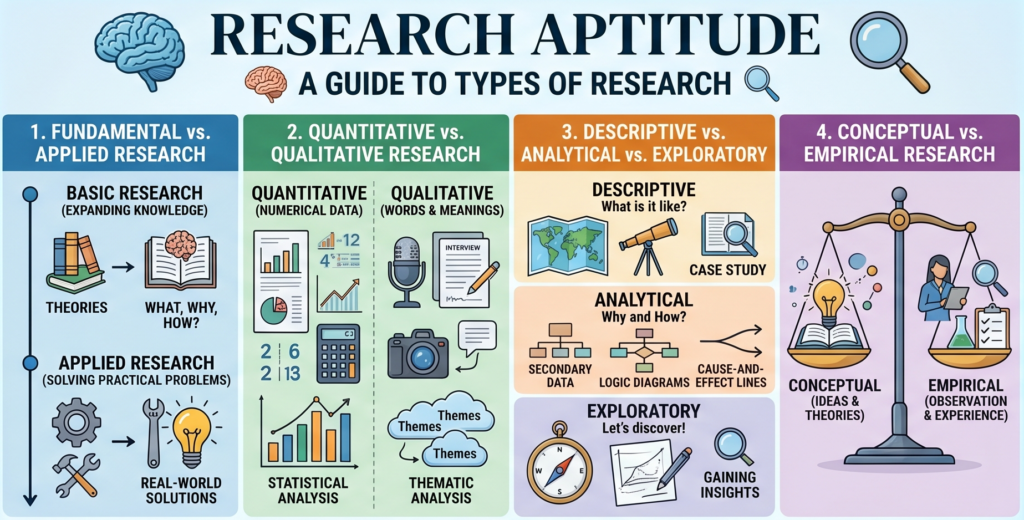
Research can be classified in multiple ways. Types of Research topic of UGC NET questions draw from all these classifications, so you need to know each one. Think of it like this — the same research project can be simultaneously categorized under different systems, just like a person can be described by their nationality, profession, and personality type all at once.
Here are the major classification systems:
Classification 1: Based on Purpose
Fundamental Research (Basic/Pure Research)
This is research done purely for the sake of knowledge. There’s no immediate practical application — the researcher is simply curious about how something works.
Example: A physicist studying the behaviour of subatomic particles isn’t trying to build a product. They want to understand the universe better.
Characteristics:
- Driven by curiosity and intellectual interest
- Adds to the existing body of knowledge
- Results may not have immediate practical use
- Often conducted in universities and research labs
- Leads to theories and principles
Real-world example for NET: A researcher studying “the psychological impact of social media on adolescent self-esteem” without designing any intervention program is doing fundamental research.
Applied Research
This is the practical cousin of fundamental research. Here, the researcher has a specific problem to solve and uses existing knowledge to find solutions.
Example: A pharmaceutical company using knowledge of biochemistry to develop a new drug for diabetes.
Characteristics:
- Problem-oriented and solution-driven
- Uses findings from fundamental research
- Results are directly applicable
- Often funded by industries, governments, or NGOs
- Leads to products, policies, or interventions
Key NET Trick: If the question describes a researcher solving a real-world problem, it’s almost always Applied Research. If they’re exploring a concept without a specific problem, it’s Fundamental.
Action Research
This is where things get interesting — and where many students get confused. Action Research is a special type where the practitioner themselves conducts research to improve their own practice.
Example: A school teacher notices that her Class 8 students struggle with fractions. She designs a new teaching method using visual aids, tries it for 3 months, observes the results, modifies her approach, and tries again. This cycle of plan → act → observe → reflect is action research.
Characteristics:
- Conducted by practitioners (teachers, doctors, managers), not professional researchers
- Aimed at solving an immediate, local problem
- Follows a cyclical process
- Results are specific to that context (not generalizable)
- Proposed by Kurt Lewin
- Also known as “classroom research” in educational settings
The Critical Difference:
| Parameter | Applied Research | Action Research |
|---|---|---|
| Who does it? | Professional researchers | Practitioners themselves |
| Scope | Broad, generalizable | Local, context-specific |
| Purpose | Solve a general type of problem | Improve one’s own practice |
| Example | “Does gamification improve learning?” (studied across 50 schools) | “Can I use gamification to help MY Class 10 learn better?” |
This distinction is a NET favourite. Don’t mix them up.
Classification 2: Based on Approach
Quantitative Research
Research that deals with numbers, measurements, and statistical analysis. If you can count it, measure it, or express it as a percentage — it’s quantitative.
Methods Used: Surveys, experiments, structured questionnaires, statistical tests
Example: “78% of UGC NET aspirants who took mock tests scored above the cutoff” — this is a quantitative finding.
Characteristics:
- Objective and measurable
- Large sample sizes
- Uses statistical tools (mean, median, chi-square, t-test)
- Results can be generalized
- Follows a structured, predetermined design
Qualitative Research
Research that deals with words, meanings, experiences, and interpretations. If you’re trying to understand how or why people feel or behave a certain way, you’re in qualitative territory.
Methods Used: Interviews, observations, case studies, focus groups, ethnography
Example: “UGC NET aspirants who took mock tests reported feeling more confident and less anxious” — this captures experience, not numbers.
Characteristics:
- Subjective and interpretive
- Small, purposive samples
- Uses thematic analysis, coding, narrative analysis
- Results are context-specific (not easily generalized)
- Design evolves during the research process
Mixed Methods Research
Combines both quantitative and qualitative approaches in a single study. This is increasingly common in modern research and has appeared in recent NET papers.
Example: A researcher surveys 500 students (quantitative) AND conducts in-depth interviews with 20 of them (qualitative) to study exam anxiety.
The Comparison Table You’ll Want to Screenshot
| Parameter | Quantitative | Qualitative | Mixed Methods |
|---|---|---|---|
| Data Type | Numbers | Words, narratives | Both |
| Sample Size | Large | Small | Varies |
| Analysis | Statistical | Thematic | Both |
| Objectivity | Objective | Subjective | Both perspectives |
| Generalizability | High | Low | Moderate |
| Flexibility | Rigid design | Flexible design | Balanced |
| Key Question | How much? How many? | How? Why? What does it mean? | Comprehensive view |
Classification 3: Based on Method
Descriptive Research
Answers the question: “What is the current situation?” It describes what exists without manipulating any variables.
Examples: Census, surveys, opinion polls, case studies
Think of it this way: A journalist reporting on the current state of education in rural India is doing descriptive work. They’re documenting reality, not changing it.
Experimental Research
Answers the question: “What happens when I change something?” The researcher manipulates an independent variable and observes its effect on a dependent variable, while controlling other factors.
Key Terms:
- Independent Variable (IV): What the researcher changes
- Dependent Variable (DV): What the researcher measures
- Control Group: Doesn’t receive the treatment
- Experimental Group: Receives the treatment
Example: Testing whether a new teaching method (IV) improves student test scores (DV) compared to traditional methods (Control Group).
Historical Research
Answers: “What happened in the past and why?” Uses primary sources (original documents, artifacts) and secondary sources (books, journals) to understand past events.
Example: Studying the evolution of India’s education policy from the Wood’s Despatch (1854) to NEP 2020.
Exploratory Research
Answers: “What is this phenomenon? Let me investigate.” Done when very little is known about a topic. It’s like being a detective entering an unknown case.
Example: When COVID-19 first emerged, early studies were exploratory — researchers were trying to understand what the virus was, how it spread, and what its effects were.
Correlational Research
Answers: “Is there a relationship between two variables?” But here’s the critical point — correlation does not imply causation.
Example: “Students who sleep 8 hours score higher in exams.” This shows a correlation, but we can’t say sleep causes higher scores without an experiment.
Ex Post Facto Research (Causal-Comparative)
The researcher studies the effect of a variable that has already occurred. They can’t manipulate it because it already happened.
Example: Studying the academic performance of students who experienced childhood trauma. The researcher didn’t cause the trauma — they’re studying its effects after the fact.
Classification 4: Based on Time Dimension
| Type | Description | Example |
|---|---|---|
| Cross-Sectional | Data collected at ONE point in time | Surveying 1000 students today about study habits |
| Longitudinal | Data collected over a LONG period | Following the same 100 students over 5 years |
| Retrospective | Looking BACK at past data | Studying medical records of patients from 2015-2020 |
| Prospective | Looking FORWARD, collecting data as events unfold | Enrolling patients today and tracking them for 3 years |
Other Important Types for NET
Conceptual vs Empirical Research
- Conceptual: Based on abstract ideas, theories, and philosophies. No data collection. Example: Philosophical analysis of the concept of justice.
- Empirical: Based on observation and data collection. Example: Surveying 500 people about their perception of justice.
Analytical Research
The researcher uses existing data or facts and analyzes them critically. It’s different from descriptive research because it goes beyond description to interpretation and evaluation.
Clinical Research
Research conducted in medical/health settings. While not a major NET topic, it occasionally appears in questions about research ethics (informed consent, Nuremberg Code, Helsinki Declaration).
The Super-Chart: All Types at a Glance
| Classification Basis | Types |
|---|---|
| Purpose | Fundamental, Applied, Action |
| Approach | Quantitative, Qualitative, Mixed |
| Method | Descriptive, Experimental, Historical, Exploratory, Correlational, Ex Post Facto |
| Time | Cross-sectional, Longitudinal, Retrospective, Prospective |
| Nature | Conceptual, Empirical, Analytical |
Tricks to Remember for Exam Day
- FAA for Purpose — Fundamental, Applied, Action (like the aviation authority — helps your research “take off”)
- QQM for Approach — Quantitative, Qualitative, Mixed
- DEHEC for Method — Descriptive, Experimental, Historical, Exploratory, Correlational (think “D-HEC” like a deck of research cards)
- Kurt Lewin = Action Research — Remember: Lewin sounds like “Lean In” — a practitioner leaning into their own practice to improve it.
Frequently Asked Questions
Key Takeaways
- Research can be classified by purpose (Fundamental, Applied, Action), approach (Quantitative, Qualitative, Mixed), method (Descriptive, Experimental, Historical, etc.), and time dimension
- Action Research is frequently confused with Applied Research — remember the practitioner vs. professional researcher distinction
- Correlation does not imply causation — a NET favourite trap
- Kurt Lewin is the father of Action Research
- Understanding these types helps you answer questions across the entire Research Aptitude unit
Want more Research Aptitude notes? Visit NETsaarthi.in for complete unit-wise study material for UGC NET Paper 1.