
Levels of Teaching in UGC NET Paper 1 — Memory, Understanding & Reflective Level Explained
Have you ever wondered why some teachers just make you memorize dates and formulas, while others push you to think, argue, and create your own ideas? That difference isn’t random — it’s actually rooted in a well-defined framework called the Levels of Teaching. If you’re preparing for UGC NET Paper 1, this is one of those golden topics that appear almost every cycle. Get it right, and you’re looking at 2-3 guaranteed marks. Let’s break it down in a way you’ll actually remember.
Why Should You Care About This Topic?
Here’s the thing — UGC NET doesn’t just ask “What are the levels of teaching?” anymore. The questions have become trickier. You might see:
- “Which level is associated with the Herbartian approach?”
- “At which level of teaching does the learner develop critical thinking?”
- “Arrange the levels of teaching from lowest to highest cognitive demand.”
Without a deep understanding, these questions can trap even well-prepared candidates. So let’s go beyond surface-level notes.
The Three Levels of Teaching
Teaching doesn’t happen at a single depth. Think of it like swimming — you can splash around in the shallow end, wade into the middle, or dive into the deep waters. Similarly, teaching operates at three progressively deeper levels:
- Memory Level (Thoughtless Teaching)
- Understanding Level (Thoughtful Teaching)
- Reflective Level (Upper Thoughtful Teaching)
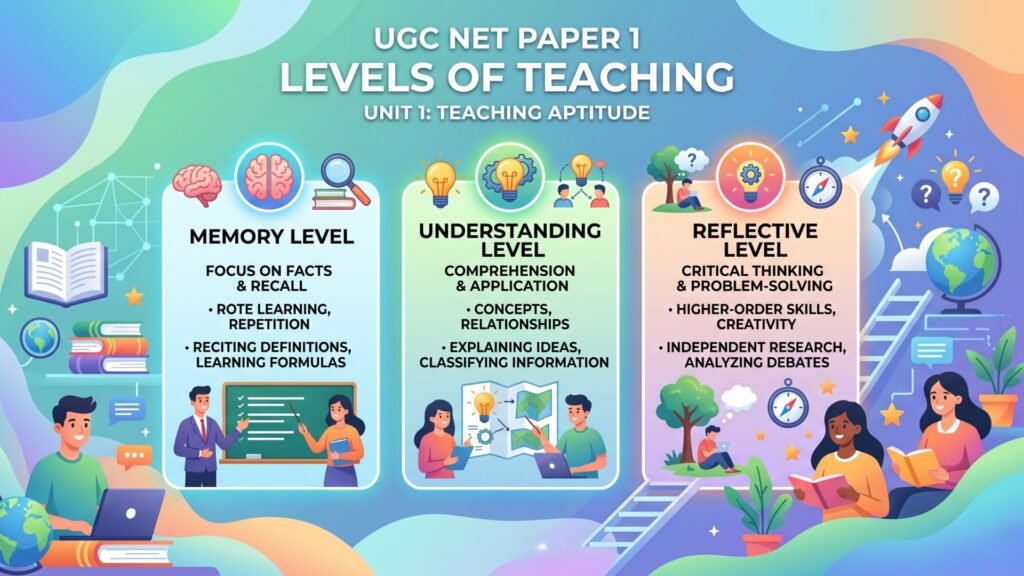
Let’s explore each one in detail.
Level 1: Memory Level of Teaching
Also Known As: Thoughtless Teaching
Before you panic — “thoughtless” doesn’t mean bad teaching. It means this level doesn’t demand much thinking from the learner. The focus is purely on memorization and recall.
Who Proposed It?
Herbart is the key thinker associated with Memory Level teaching. His model revolves around five systematic steps:
| STEP | WHAT HAPPENS |
|---|---|
| Preparation | The teacher prepares students by connecting to previous knowledge |
| Presentation | New content is presented clearly |
| Association | New knowledge is linked to existing knowledge |
| Generalisation | Broad principles or rules are derived |
| Application | Students apply the learned rules to new situations |
What Does It Look Like in a Classroom?
Imagine a history class where the teacher says, “The Battle of Plassey was fought in 1757. Robert Clive defeated Siraj-ud-Daulah. Now repeat after me…”
The students memorize. They can reproduce the answer in exams. But ask them why Plassey changed India’s political landscape, and you’ll get blank stares.
Key Characteristics of Memory Level
- Cognitive Level: Lowest — only recall and recognition
- Teacher’s Role: Dominant, autocratic
- Student’s Role: Passive listener, takes notes
- Evaluation: Objective tests — fill in the blanks, true/false, MCQs
- Motivation: Extrinsic (marks, punishments, rewards)
- Criticism: Encourages rote learning, kills creativity
When Is It Useful?
Don’t dismiss memory-level teaching entirely. It’s essential for:
- Learning multiplication tables
- Memorizing chemical formulas
- Remembering important dates and names
- Building the foundational vocabulary of any subject
The problem arises when teaching stays at this level and never goes deeper.
Level 2: Understanding Level of Teaching
Your AttracAlso Known As: Thoughtful Teaching
This is where learning gets interesting. The teacher doesn’t just present facts — they help students understand relationships, see patterns, and grasp the “why” behind the “what.”
Who Proposed It?
Morrison is the key thinker here. His approach has five steps, too, but they’re fundamentally different from Herbart’s:
| STEP | WHAT HAPPENS |
|---|---|
| Exploration | The teacher assesses students’ existing knowledge through pre-tests |
| Presentation | Concepts are taught with explanations and reasoning |
| Assimilation | Students internalize concepts through discussions and activities |
| Organisation | Students organize learned material in their own words |
| Recitation | Students present their understanding — could be oral or written |
What Does It Look Like in a Classroom?
Same history class, different approach: “The Battle of Plassey happened in 1757. But let’s understand — why did it happen? What role did the internal politics of Bengal play? How did the East India Company exploit the situation?”
Now students aren’t just remembering a date. They’re understanding cause and effect.
Key Characteristics of Understanding Level
- Cognitive Level: Medium — analysis, comparison, explanation
- Teacher’s Role: Democratic, facilitator
- Student’s Role: Active participant, asks questions
- Evaluation: Short answers, essays, case studies
- Motivation: Mix of intrinsic and extrinsic
- Strength: Develops intellectual skills and deeper comprehension
- Limitation: Still teacher-directed; students follow the teacher’s logic, not their own
The Morrison Test-Teach-Test Cycle
Morrison believed in a cycle: test → teach → test → adapt → re-teach → test again — until the student demonstrates mastery. This is remarkably similar to modern concepts like “mastery learning” used in ed-tech platforms today.
Level 3: Reflective Level of Teaching
Also Known As: Upper Thoughtful Teaching
This is the highest and most sophisticated level of teaching. Here, the student doesn’t just understand — they question, evaluate, create, and develop original thinking.
Who Proposed It?
Hunt is the key thinker associated with Reflective Level teaching. This level is also deeply connected to Bloom’s higher-order thinking skills (Analysis, Synthesis, Evaluation).
What Does It Look Like in a Classroom?
Back to our history class: “We’ve studied the Battle of Plassey. Now, here’s a question — was Clive a strategic genius or just lucky? Could the battle have been avoided? If you were Siraj-ud-Daulah’s advisor, what would you have done differently? Write a 500-word argument defending your position.”
Now students are doing something remarkable — they’re creating knowledge, not just consuming it.
Key Characteristics of Reflective Level
- Cognitive Level: Highest — critical thinking, problem-solving, creativity
- Teacher’s Role: Facilitator, co-learner, guide on the side
- Student’s Role: Independent thinker, researcher, debater
- Evaluation: Projects, research papers, debates, open-ended problems
- Motivation: Purely intrinsic — curiosity, passion for learning
- Strength: Develops original thinking and problem-solving abilities
- Limitation: Time-consuming, not suitable for all topics or age groups
The Ultimate Comparison Table
This is your revision gold. Save this table — it covers everything of Levels of Teaching from which UGC NET can ask:
| Parameter | Memory Level | Understanding Level | Reflective Level |
|---|---|---|---|
| Also Called | Thoughtless | Thoughtful | Upper Thoughtful |
| Key Thinker | Herbart | Morrison | Hunt |
| Cognitive Demand | Low (Recall) | Medium (Comprehension) | High (Analysis, Creation) |
| Teacher Role | Autocratic | Democratic | Facilitator |
| Student Role | Passive | Active participant | Independent thinker |
| Classroom Climate | Subject-centered | Teacher-student centered | Learner-centered |
| Evaluation | Objective tests | Short answers, essays | Research, projects, debates |
| Motivation | Extrinsic | Mixed | Intrinsic |
| Thinking Involved | Minimal | Moderate | Maximum |
| Bloom’s Level | Knowledge | Comprehension, Application, | Analysis, Synthesis, Evaluation |
| Example Activity | Recite a poem | Explain poem’s meaning | Write your own poem on the same theme |
How to Remember This for Exam Day
Here’s a mnemonic that has saved thousands of NET aspirants:
“MUR — Memory, Understanding, Reflective”
Think of it as a wall (MUR means wall in French) — you build knowledge brick by brick:
- First brick = Memory (foundation)
- Second brick = Understanding (structure)
- Third brick = Reflective (the roof — highest point)
Another trick: H-M-H for the thinkers:
- Morrison → Understanding
- Herbart → Memory
- Hunt → Reflective
Previous Year Questions (Patterns You Must Know)
Here are the types of questions on Levels of Teaching UGC NET has asked on this topic:
- Type 1: Direct Identification “Reflective level of teaching is associated with which thinker?” Answer: Hunt
- Type 2: Matching “Match the following: Memory Level — ?, Understanding Level — ?, Reflective Level — ?”
- Type 3: Application-Based “A teacher asks students to critically evaluate a government policy and propose alternatives. This represents which level of teaching?” Answer: Reflective Level
- Type 4: Sequencing “Arrange in ascending order of cognitive involvement: Reflective, Memory, Understanding” Answer: Memory → Understanding → Reflective
Common Mistakes to Avoid
- Confusing Herbart with Morrison — Herbart = Memory (both have 5 steps, but Herbart is about memorization). Morrison = Understanding (his test-teach-test cycle demands comprehension).
- Thinking Memory Level is “bad” — It’s not. It’s the foundation. You can’t understand calculus without first memorizing basic multiplication.
- Assuming Reflective Level works everywhere — You wouldn’t teach a 5-year-old the alphabet through reflective teaching. The level must match the content and the learner’s maturity.
How This Connects to Other Paper 1 Topics
The beauty of UGC NET Paper 1 is that topics are interconnected. Here’s how Levels of Teaching links to other units:
- Communication — One-way communication = Memory Level teaching, Interactive = Understanding, Transactional = Reflective
- Bloom’s Taxonomy (Teaching Aptitude) — Memory Level maps to Knowledge, Understanding to Comprehension/Application, Reflective to Analysis/Synthesis/Evaluation
- Methods of Teaching — Lecture method = Memory Level, Discussion method = Understanding Level, Problem-solving method = Reflective Level
- Research Aptitude — Research methodology itself is a reflective-level activity
Frequently Asked Questions
Key Takeaways
- Teaching operates at three levels: Memory (Herbart), Understanding (Morrison), and Reflective (Hunt)
- Each level has a distinct teacher role, student role, and evaluation method
- The levels are progressive — from lowest cognitive demand to highest
- UGC NET loves asking matching, sequencing, and application questions on this topic
- Understanding the interconnections with Bloom’s Taxonomy and teaching methods gives you an edge
Preparing for more Paper 1 topics? Check out our complete unit-wise notes on NETsaarthi.in — your UGC NET journey, simplified.
Leadership Theories UGC NET Management — Trait, Behavioural & Situational (2026)
Leadership Theories UGC NET Management — Trait, Behavioural & Situational (2026) Is a leader born…
Marketing Mix UGC NET — 4Ps, 7Ps & STP Strategy Explained (2026)
Marketing Mix UGC NET Management— 4Ps, 7Ps & STP Strategy Explained (2026) Every time you…
Research Ethics UGC NET Paper 1 — Plagiarism, Thesis & Ethics Guide (2026)
Research Ethics UGC NET Paper 1 — Plagiarism, Thesis & Ethics Guide (2026) Picture this…
Types of Research in UGC NET Paper 1 — Fundamental, Applied, Action & More
Types of Research UGC NET Paper 1 — Complete Guide with Examples (2026) If Teaching…
UGC NET Syllabus 2026 — Paper 1 & Paper 2 Management Complete Breakdown
UGC NET Syllabus 2026 — Paper 1 & Paper 2 Management Complete Breakdown Before you…
Fayol’s 14 Principles of Management UGC NET 2026
Fayol’s 14 Principles of Management UGC NET If you’ve ever worked in an organization —…